
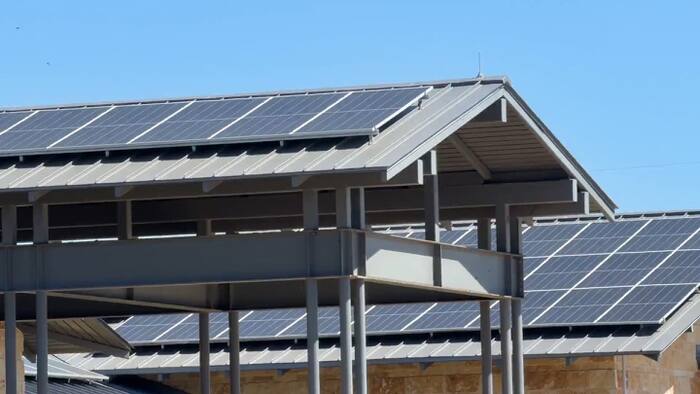
For roughly three years, the City of San Antonio has been installing solar panels on rooftops and carport canopies at dozens of city-owned sites, from libraries to fire stations to senior centers.
That work could finally be completed by the end of 2027 — a year later than originally anticipated, but still on budget.
Councilmembers approved a $30.8 million contract with Big Sun Solar in November 2023 for the on-site solar program, which city officials say is the first of its kind in Texas. At the time of its approval, at least, it was the second-largest in the nation, behind New York City.
Part of the city’s climate plan is to make all city buildings zero net energy by 2040. The city hopes the solar program will offset 11% of city electricity use at municipal buildings and reduce 18% of city-owned building greenhouse gas emissions.
It could also save $1.8 million each year.
“That’s great because every dollar we’re not spending on utility bills, we’re reinvesting into our assets,” Ashe Williams, energy manager for the Department of Resilience and Sustainability, told KSAT.
The city originally envisioned 42 sites, to be completed by the end of this year. The project list, though, has jumped to 52 sites.
Williams said some of the original sites didn’t turn out to be financially feasible. However, the city also added several libraries to the plans, and some larger projects — like the Central Library parking garage — were split up.
With 35 sites now completed, the city believes it will have the final 17 done before the end of next year.

“The schedule that was initially created was based on meeting certain permitting approvals, milestones, as well as this initial list of 40 sites,” explained Laura Patiño, the director of the Department of Resilience and Sustainability
“We’ve had to re-evaluate certain sites and identify alternatives, as well as go through different permitting processes with different entities, including our partners within CPS Energy. Some have required easements, and that adds on additional layers of review for each project.”
At the time she spoke to KSAT in early October, there were still 18 projects to go. However, Patiño told KSAT it had only taken about six months to implement the previous 14.
She estimated there was “plenty of time” to complete the final projects by the end of 2027.
Williams told KSAT she hopes other departments will look to solar energy as an initial investment for new buildings instead of being something they add later.
“We want this project to be an example for how the city should operate moving forward. That would be the ultimate dream,” she said.
Read also:


